> For the complete documentation index, see [llms.txt](https://docs.bdb.ai/bdb-documentation/llms.txt). Markdown versions of documentation pages are available by appending `.md` to page URLs; this page is available as [Markdown](https://docs.bdb.ai/bdb-documentation/data-visualization/governed-dashboards/charts-gallery/filters/checkbox.md).
# Checkbox
{% hint style="success" %}
*Check out the given walk-through to understand the Check Box filter component.*
{% endhint %}
Check Box is used to filter data on any associated components. Enabling a check box will change the data displayed in the associated components.
**Best Situation to use Check Box:**
* To filter data displayed in the associated components
* To select multiple items at a time
#### Default Checkbox Image:
### Properties of the Check Box filter:
#### **General**
* The user can change the height, width, top and left position of the check box filter component.
* The user can set a name to the label and change its font color-style-weight-family from the General Properties.
* If the ***Show Checked*** option is enabled, then by default a checkmark will get enabled.
* Chrome color is used to set the component background, also the user can change its transparency.
* A value can be set to the ***Checked Value*** so that when the user clicks on the check box, this value will get passed.
{% hint style="info" %} Please Note: *If initial visibility is not enabled, then the chart won’t be available for the first preview.*
{% endhint %}

#### **Background**
* The user can get the reflection of the chart by enabling the shadow option.
* The user can also change the color and increase/decrease the transparency of the shadow.

#### Modified Check box filter after changing its properties:

### Check Box Use Case
The following use case explains how to connect and use a Checkbox with a Data Grid component.
* Drag a Data Grid component to the Designer canvas.
* Associate a Data Connection with it.
* Drag a Check Box component from the Filter group to the canvas.
* Open the Check box Properties, provide the necessary properties, and apply them.
* Provide the text for the Label.
* Provide the Checked Value.
* Keep the Unchecked Value blank.
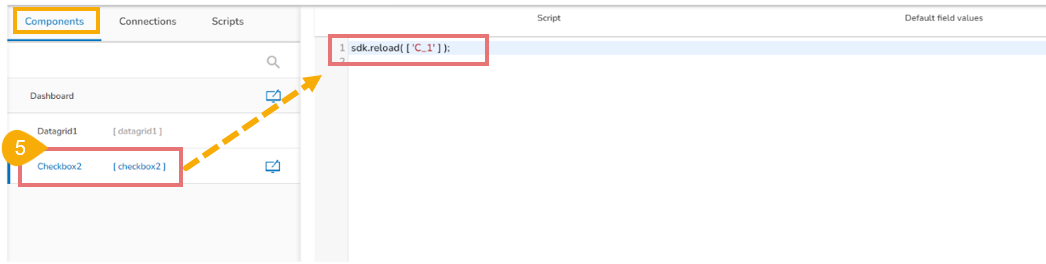
* Use the component object page to write the required script at the component level.
* Configure the Condition tab by providing a field value for the conditions (the field State is chosen in the given image).
* Click the ***Preview*** icon to preview the Dashboard.

* Use a check mark in the given box to display the ***Checked Value*** in the chart.
* Uncheck the Check Box to display the ***Unchecked Value*** in the chart (In this case, no value has been assigned as Unchecked Value so it will display all the records).