> For the complete documentation index, see [llms.txt](https://docs.bdb.ai/bdb-documentation/llms.txt). Markdown versions of documentation pages are available by appending `.md` to page URLs; this page is available as [Markdown](https://docs.bdb.ai/bdb-documentation/data-science-lab/various-tabs-to-work-with/notebook/notebook-page/notebook-operations/save-artifacts.md).
# Save Artifacts
Save plots and datasets inside Notebook as Artifacts
{% hint style="success" %}
*Check out the walk-through on how to Save Artifacts.*
{% endhint %}

{% hint style="info" %} Please Note: *The user can save the artifacts of a predicted model using this option.*
{% endhint %}
* Add a new cell.
* Click the ***Save Artifacts**.*
* Give proper dataframe name and Name of Artifacts (with extensions - .csv/.txt/.json)
* Execute the cell.
* The Artifacts get saved.

{% hint style="info" %} Please Note: *The saved **Artifacts** can be downloaded as well.*
{% endhint %}
## Save Plot as Artifacts
* Navigate to a notebook.
* Define the save statement in the code cell for the plot you want to save as artifacts.
* Execute the cell.
* Refresh the ***Artifacts*** tab.

* The plot will get saved under the Artifacts space as .png file.

* Once the Artifacts is saved you can download it.

* The plot will get downloaded as .png file.

{% hint style="info" %}
*Please Note: The user can also get an instant visual depiction of the data based on their executed scripts.*

{% endhint %}
### Download the saved Artifacts
The user can download the saved Artifacts from the Notebook page.
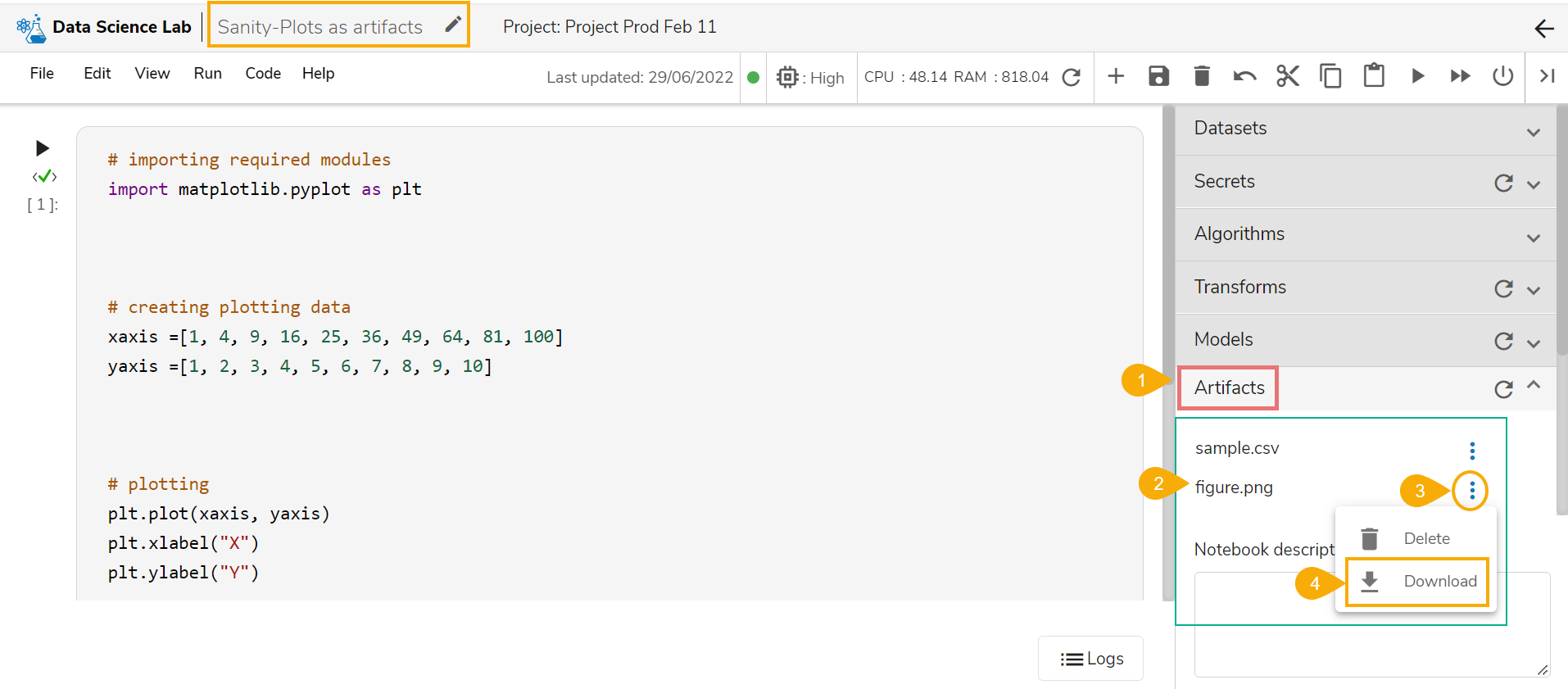
* Navigate to the ***Artifacts*** option on the Notebook page and click on it.
* The list of the saved Artifacts opens.
* Click the vertical ellipses icon.
* You can get the Download option in the context menu. Click on the ***Download*** option.
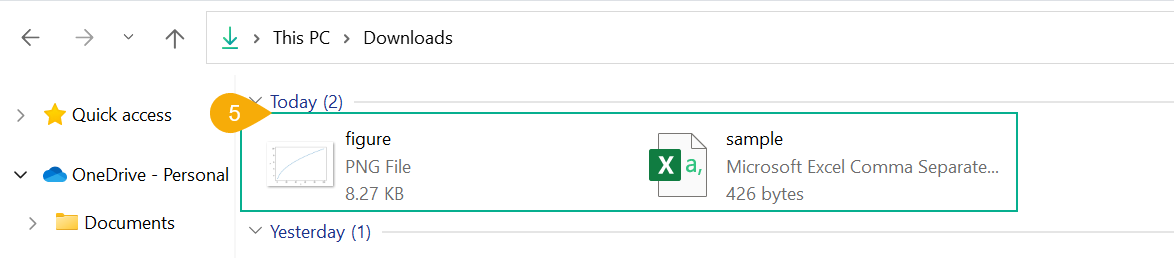
* Based on the selected Artifact file type it will get downloaded to your system.
 icon.
* You can get the Download option in the context menu. Click on the ***Download*** option.
icon.
* You can get the Download option in the context menu. Click on the ***Download*** option.