> For the complete documentation index, see [llms.txt](https://docs.bdb.ai/data-pipeline-4/llms.txt). Markdown versions of documentation pages are available by appending `.md` to page URLs; this page is available as [Markdown](https://docs.bdb.ai/data-pipeline-4/components/consumers/opc-ua.md).
# OPC UA
**OPC UA (OPC Unified Architecture)** is a communication protocol and standard used for collecting and transmitting data from industrial devices and systems to a data processing or analytics platform. OPC UA is commonly employed in data pipelines for handling data from industrial and manufacturing environments, making it an integral part of industrial data pipelines.
All component configurations are classified broadly into the following sections:
* [Basic Information](/data-pipeline-4/components/component-base-configuration.md)
* Meta Information
* [Resource Configuration](/data-pipeline-4/components/resource-configuration.md)
## **Basic Information Tab**
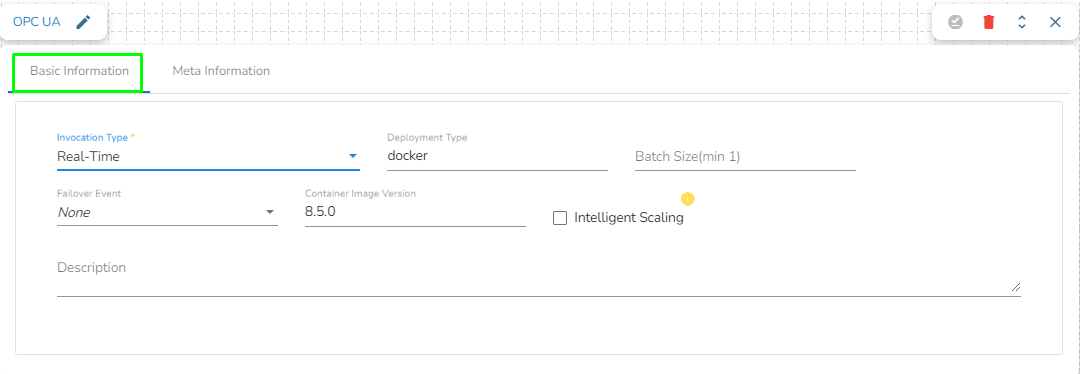
Basic information tab
It is the default tab to open for the component while configuring it.
* **Invocation Type:** Select an invocation mode out of ‘Real-Time’ or ‘Batch’ using the drop-down menu.
* **Deployment Type:** It displays the deployment type for the reader component. This field comes pre-selected.
* **Container Image Version:** It displays the image version for the docker container. This field comes pre-selected.
* **Failover Event:** Select a failover Event from the drop-down menu.
* **Batch Size (min 10):** Provide the maximum number of records to be processed in one execution cycle (Min limit for this field is 10).
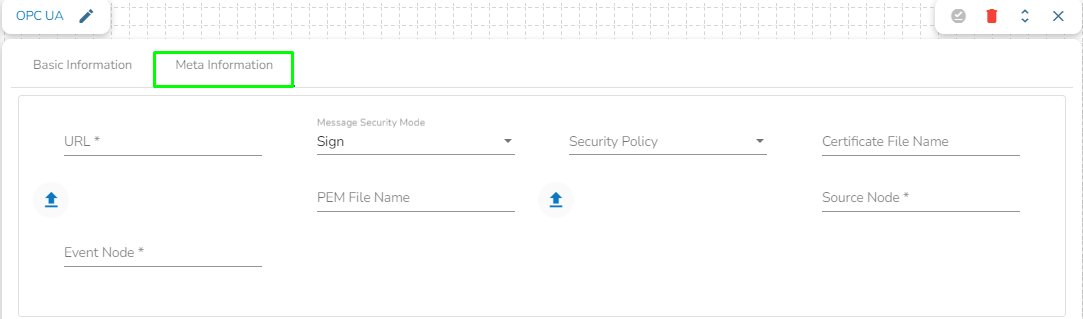
## **Steps to configure the meta information of OPC UA**
* **URL:** Provide URL link. In OPC UA (OPC Unified Architecture), a URL (Uniform Resource Locator) is used to specify the address or location of an OPC UA server or endpoint. URLs in OPC UA are typically used to establish connections to servers and access the services provided by those servers.
* **Message Security Mode:** Select a message security mode from the drop-down menu (The supported options are ‘***Sign***’ and ‘***SignAndEncrypt***’).
* **Security Policy:** Select a policy using the drop-down menu. Three types of security policies are supported:
* **Basic256:** ***Basic256*** is a security profile that provides encryption and signature capabilities for OPC UA communication. It uses a 256-bit encryption key. All messages exchanged between clients and servers are encrypted using a 256-bit encryption key, providing data confidentiality. Messages are digitally signed to ensure data integrity and authenticity. Signature algorithms ensure that the message has not been tampered with during transmission. ***Basic256*** uses symmetric encryption, meaning both parties share the same secret key for encryption and decryption.
* **Basic256Sha256: *****Basic256Sha256*** is an enhanced security profile that builds upon the features of ***Basic256***. It offers stronger security by using ***SHA-256*** cryptographic algorithms for key generation and message digests.
* **Basic128Rsa15: *****Basic128Rsa15*** is a security profile that uses 128-bit encryption and ***RSA-15*** key exchange. It is considered less secure compared to ***Basic256*** and ***Basic256Sha256***. ***Basic128Rsa15*** uses 128-bit encryption for data confidentiality. It relies on the ***RSA-15*** key exchange mechanism, which is considered less secure than newer RSA and elliptic curve methods.
* **Certificate File Name:** This name gets reflected based on the Choose File option provided for the Certificate file.
* **Choose File:** Browse a certificate file by using this option.
* **PEM File Name:** This name gets reflected based on the Choose File option provided for the PEM file.
* **Choose File:** Browse a PEM file by using this option.
* **Source Node:** Enter the source node. The ***"Source Node"*** refers to the entity or component within the OPC UA server that is the source or originator of an event or notification. It represents the object or node that generates an event when a specific condition or state change occurs.
* **Event Node:** Enter the event node. The ***"Event Node"*** refers to the specific node in the OPC UA AddressSpace that represents an event or notification that can be subscribed to by OPC UA clients. It is a node that defines the structure and properties of the event, including the event's name, severity, and other attributes.